The Wall Has Fallen: AWS's Move to Turn AI Into a Commodity
By selling Trainium chips outside its ecosystem, Amazon shatters the walled garden model and forces Nvidia to trade its architectural monopoly for a margin war.
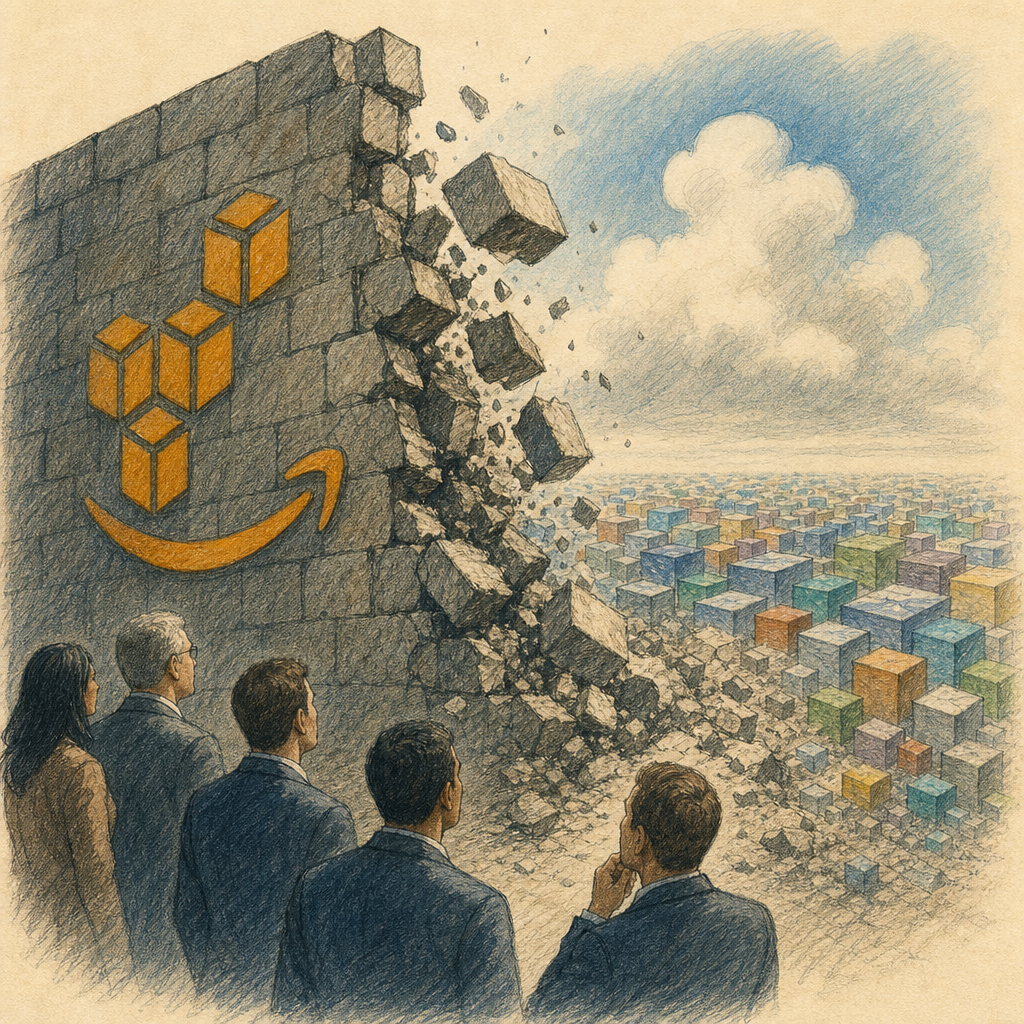
For over a decade, the strategy of hyperscalers like AWS was orthodox: build the moat, erect the wall, and charge a toll on everything that moves inside it. Customers wanting the best of the cloud had to accept native silicon bundled into their rentals. Now, Amazon is about to break its own contract. According to TechCrunch, AWS is in negotiations to sell its AI chips, the Trainium line, directly to third-party data centers. This is no philosophical essay on interoperability; it is a chess move by a company that has realized the future of AI infrastructure no longer fits inside a single backyard.
CEO Andy Jassy has labeled this opening a $50 billion opportunity. It is a number that by itself justifies the shift in posture, but what it truly reveals is a grim diagnosis for the traditional cloud model: if AI computing power is going to spread across corporate data centers and sovereign clouds worldwide, the hyperscaler that insists on being a walled garden will watch the dinner party happen at the neighbor's house. Selling silicon to the outside is an admission that AWS cannot—and perhaps should not—single-handedly house the world's hunger for model inference and training.
The obvious target of this maneuver is Nvidia. Until now, Jensen Huang's empire operated as an architecture monopoly backed by an impenetrable software ecosystem (CUDA). Nvidia wasn't just selling a piece of hardware; it was selling the only gateway to AI paradise. By putting Trainium on the street, AWS injects a commodity dynamic into the market. If Amazon's chips can run workloads at a lower operational cost—even with less raw performance—the dispute ceases to be about who has the best architecture and becomes about who can afford to cut margins to the bone.
In my reading, this move marks the end of the era when AI silicon was a non-negotiable luxury item. When hardware becomes a wholesale commodity, bargaining power shifts sides. Nvidia will be forced to justify its astronomical prices not merely with the ecosystem argument, but with pure return-on-investment math. It is a brutal transition: we have moved from a lack of alternatives to relative abundance.
What we are witnessing is cloud architecture unraveling to make way for the architecture of controlled chaos. AI infrastructure is becoming a distributed asset, scattered around, where the owner of the best and cheapest silicon dictates the pace—not the platform owner. By abandoning exclusivity to chase Jassy's $50 billion, AWS is not just challenging Nvidia; it is warning the market that the garden wall has become a museum piece.
Why is AWS selling its Trainium chips to third-party data centers?
AWS is selling Trainium chips externally because AI computing power is spreading across corporate and sovereign clouds globally. CEO Andy Jassy views this as a $50 billion opportunity, acknowledging that AWS cannot single-handedly house the world's demand for AI training and inference.
How does AWS selling Trainium chips threaten Nvidia?
By offering Trainium externally, AWS introduces a commodity dynamic that challenges Nvidia's architectural monopoly and CUDA ecosystem. It shifts the market competition from software ecosystem lock-in to a margin war, forcing Nvidia to justify its premium prices through pure return-on-investment math.
What does AWS's strategy mean for the future of cloud architecture?
It signals the end of the traditional hyperscaler walled garden. AI infrastructure is becoming a distributed asset where the owner of the most cost-effective silicon dictates the pace, rather than the cloud platform owner.